
Free U.S. shipping over $75  ·  60-Night Sleep Trial  ·  Free returns
The Silk Guide

Momme, grades and care — the whole silk label, explained

Silk listings are full of numbers that look precise and mean very little. This guide explains what each one actually measures, so you can compare two pillowcases honestly — ours included.

One-page summary

The whole guide, on one page

Momme weight, silk grade, silk versus satin, and the four care rules — as a single visual reference you can save, print, or send to whoever is telling you that their satin pillowcase is silk.

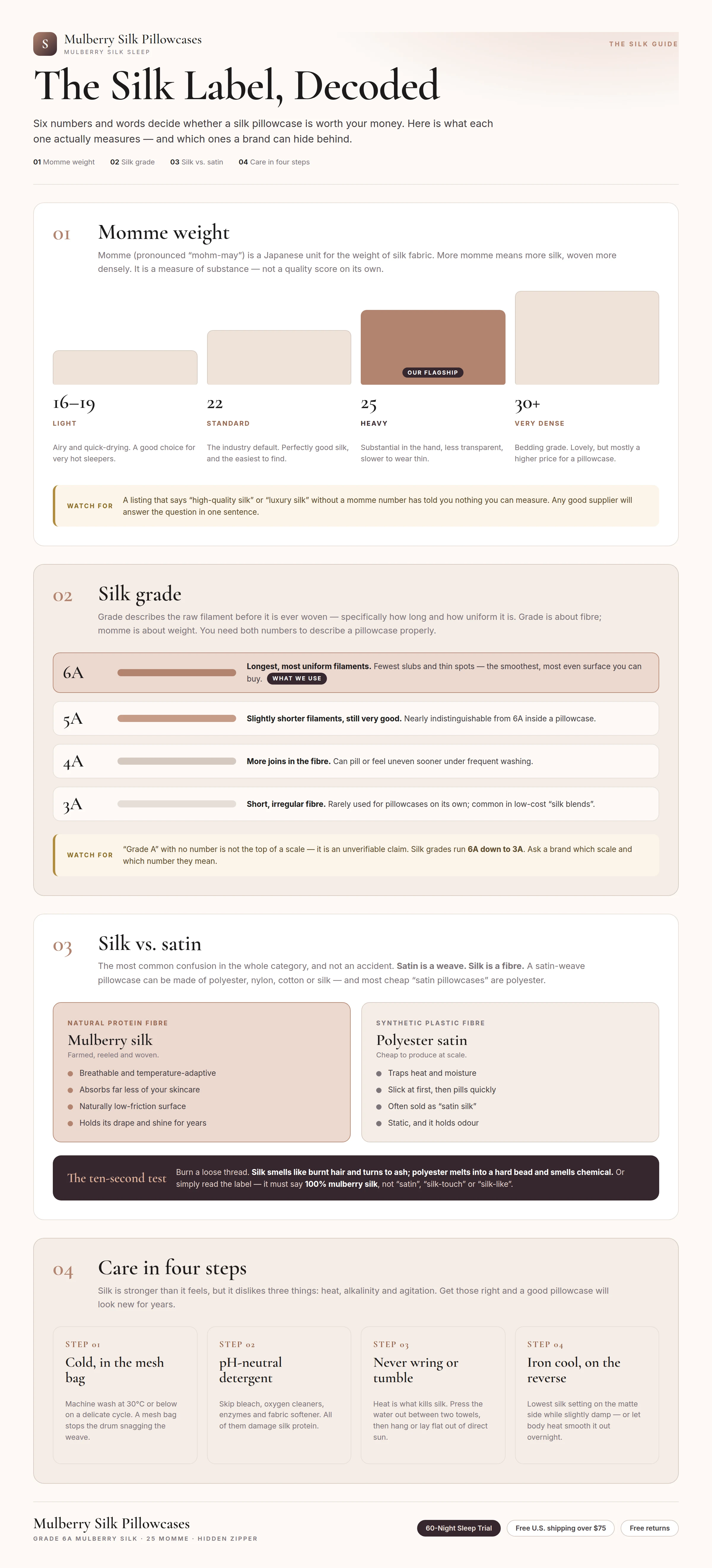
Infographic: The Silk Label, Decoded. Panel one, momme weight on a scale of 16–19 light, 22 standard, 25 heavy and 30 or more very dense, with 25 marked as the Mulberry Silk Pillowcases flagship. Panel two, silk grades from 6A, the longest and most uniform filaments, down to 3A and below, with 6A marked as what Mulberry Silk Pillowcases uses. Panel three, mulberry silk compared with polyester satin, plus the ten-second burn test for telling them apart. Panel four, care in four steps: wash cold in the mesh bag, use a pH-neutral detergent, never wring or tumble dry, and iron cool on the reverse.
The Silk Label, Decoded — momme weight, silk grades, silk vs. satin, and care. Download the infographic (PNG, 2400 × 5282)
Guide 01

Momme Weight Explained

Momme (written "mm" in the trade, and pronounced "mohm-may") is a Japanese unit used to measure the weight of silk fabric. It works like a paper weight measurement: for a fixed area of cloth, a higher momme means more silk and a denser weave.

Technically, one momme is the weight in pounds of a piece of silk 45 inches wide and 100 yards long — roughly 3.75 grams per square metre. You don't need to remember that. What matters is the practical range:

16–19 mm Light
22 mm Standard
25 mm Heavy
30 mm+ Very dense

The practical answer

19 momme feels light and airy — good for hot sleepers. 22 momme is the industry standard and perfectly good. 25 momme is our flagship: heavier in the hand, slower to wear, and the point at which silk stops feeling delicate.

Anything above 30 momme is bedding-grade silk. It's lovely, but for a pillowcase the difference over 25 is small and the price gap is not.

Two warnings about momme claims

  • "High momme" with no number is not a claim. A listing that says "high-quality 6A silk" without a momme figure is telling you nothing measurable.
  • Momme and durability aren't linear. Going from 19 to 22 changes the feel noticeably; going from 25 to 30 mostly changes the price.

See our 19, 22 and 25 momme options

Guide 02

Silk Grades Explained

Grade describes the quality of the raw silk filament, before it is ever woven. It is about fibre length and consistency, not weight — which is why a pillowcase needs both numbers to be described properly.

Silk fibre grades, from longest filament to shortest.
GradeFilament qualityWhat you'd notice
6ALongest, most uniform filamentsFewer slubs and thin spots; the smoothest, most even surface. This is what we use.
5ASlightly shorter, still very goodNearly indistinguishable in a pillowcase; common in mid-range bedding.
4AShorter filaments, more joinsMay pill or feel uneven sooner under frequent washing.
3A and belowShort, irregular fibreRarely used for pillowcases; common in low-cost "silk blend" fabric.

The "Grade A" trap

Some listings advertise "Grade A silk" as though it were the top of the scale. There is no single, universally enforced "Grade A" standard. Grading scales in the trade run 6A down to 3A, and 6A is the highest. If a brand says "Grade A" without a number, ask them which scale and which number they mean — a good supplier will answer immediately.

A useful test: ask any silk brand for the grade and the momme weight together. Brands that know their supply chain answer in one sentence. Brands that don't will send you a paragraph about luxury.
Guide 03

Silk vs. Satin — they are not the same word

This is the single most common confusion in the category, and it is not an accident. Satin is a weave. Silk is a fibre. A satin-weave pillowcase can be made of polyester, nylon, cotton, or silk — and most of the cheap "satin pillowcases" sold online are polyester.

Mulberry silk

  • A natural protein fibre
  • Breathable and temperature-adaptive
  • Absorbs far less of your skincare
  • Naturally low-friction surface
  • Costs more because it is farmed and reeled

Polyester satin

  • A synthetic plastic fibre
  • Traps heat and moisture
  • Slick at first, pills quickly
  • Cheap to produce at scale
  • Often sold as "satin silk"

How to tell them apart in ten seconds. Hold a flame near a loose thread — silk smells like burnt hair and turns to ash; polyester melts into a hard bead and smells chemical. Or read the label: it must say 100% mulberry silk, not "satin", "silk-touch" or "silk-like".

Guide 04

How to Care for Silk Pillowcases

Silk is stronger than it feels, but it does not like heat, alkalinity or agitation. Get those three things right and a good pillowcase will look new for years. Here's the routine we recommend — it takes about five minutes.

STEP 01

Wash in the mesh bag, cold

Every order includes a mesh laundry bag. Machine wash on cold, delicate, at 30°C or below. Warm water dulls the sheen over time.

STEP 02

Use a pH-neutral detergent

Skip bleach, oxygen cleaners, enzymes and fabric softener — all of them damage silk protein. A gentle silk or wool wash is ideal.

STEP 03

Never wring or tumble dry

Heat is what kills silk. Press the water out between two towels, then hang or lay flat to dry away from direct sunlight.

STEP 04

Iron cool, on the reverse

If you iron at all, use the lowest silk setting on the matte side while slightly damp. Or just let body heat smooth it out overnight.

Common care mistakes

  • Washing with towels. Towel loops snag silk. Wash pillowcases with other delicates, or alone.
  • Leaving it damp. Damp silk left in a pile can develop a musty smell and permanent creases.
  • Dry cleaning every time. Unnecessary, expensive, and the solvents are harsher than a cold gentle cycle.
  • Bleach for stains. Use a drop of pH-neutral soap and cold water instead — bleach yellows silk permanently.
How often? Every one to two weeks, the same as your sheets. Silk stays cleaner than cotton because it absorbs less oil and product — but it still collects them.

Why our pillowcase has no zipper or seams

Reference

Silk FAQ

What does 25 momme mean in plain English?

It means the fabric is dense and heavy for silk. In practice a 25-momme pillowcase feels more substantial in the hand than a 22-momme one, drapes with less transparency, and takes longer to wear thin.

Is 6A silk better than 5A?

Yes, marginally. 6A uses the longest, most uniform filaments, which means fewer slubs and a more even surface. In a pillowcase the difference between 6A and 5A is subtle; the difference between 6A and 4A shows up over months of washing.

Can I put silk in the washing machine?

Yes — cold, delicate, in a mesh bag, with pH-neutral detergent. Hand washing is gentler but not required, and a pillowcase you're afraid to wash is a pillowcase you won't use.

Will silk help my hair or my skin?

Silk creates less friction than cotton, so hair is less likely to tangle and break overnight, and skin is less likely to crease or lose moisture. It absorbs less of your skincare than cotton does. It is a genuinely better sleep surface — not a medical treatment, and we won't pretend otherwise.

Why is silk more expensive than cotton?

Silk is farmed, reeled and woven rather than grown and milled. A single silk cocoon yields roughly 300–900 metres of usable filament, and only the best cocoons produce 6A grade fibre. The labour and the loss rate are both high.

Why doesn't a silk pillowcase need a zipper?

It doesn't, and we think it is better without one. A zipper is the only component on a pillowcase that can break: the teeth catch hair, the tape is usually polyester rather than silk, and detergent, heat and softener slowly attack the mechanism until the slider seizes. When that happens the pillowcase is unusable — you cannot get a pillow in or out of it. Silk fabric, by contrast, wears out very slowly. Removing the zipper removes the failure point. Full explanation

Still deciding?

Start with one 25-momme pillowcase. You have 60 nights to change your mind, and we pay the return shipping.

Shop Silk Pillowcases